
AssayProven™ Immunoassay Reagents for Faster IVD Assay Development
Start stronger. Screen less. Optimize faster.
A Stronger Starting Point for Assay Development
Developing an IVD immunoassay can require screening large numbers of antibodies and antigens, troubleshooting incompatible combinations, and generating performance data before your team can confidently move into assay optimization.
AssayProven™ gives IVD immunoassay developers a stronger starting point. Every AssayProven™ curated reagent is:
-
Supported by extensive performance data.
-
Comprehensively characterized.
-
Tested in a commercially relevant assay format.
-
Part of a validated matched antibody pair.
-
Rigorously screened and selected from our extensive network.
Reduce Troubleshooting and Rework
Speed Reagent Selection
Extensive comparative screening helps narrow the field to stronger-performing candidates before evaluation begins.
Build with Greater Confidence

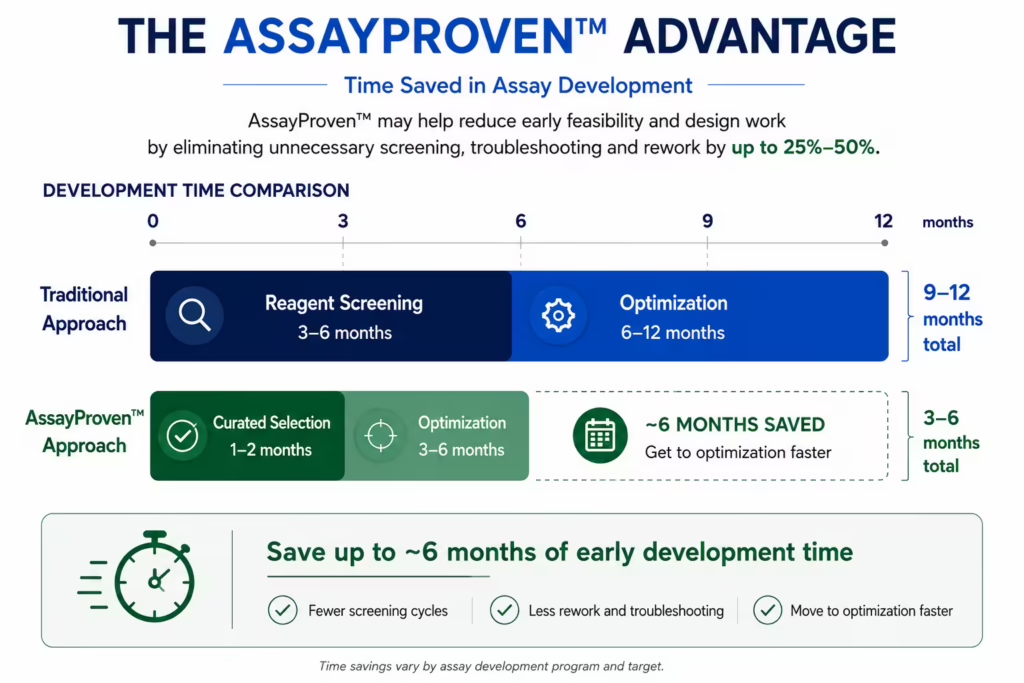
Development Time Saved
AssayProven™ may help reduce early feasibility and design work by shortening screening, troubleshooting, and rework by up to 25%-50%.
What is AssayProven™
AssayProven™ is a curated portfolio of antibodies and antigens organized around selected assay component combinations and supported by product-specific characterization information for IVD assay development.
A Curated Component Approach
Rather than presenting antibodies and antigens only as individual products, AssayProven™ brings selected reagents together in recommended combinations for specific targets and applications.
Product-Specific Performance Information
Learn more about AssayProven™.
Benefits
- Selected assay component combinations
- Product-specific characterization data
- Relevant assay-format context
- Supporting technical information
Featured AssayProven™ Reagents
Explore AssayProven™ reagents across infectious disease, TORCH, tropical disease, cardiac, thyroid, allergy, and neurological disease applications. Product-specific performance information and documentation vary by reagent.
| Application | Assay Target | Target Type | Tested Assay Format* | Recommended catalog pair | Performance Evaluation Material |
|---|---|---|---|---|---|
| Neurological disease markers | GFAP | Antigen | CLIA | AXGFA01RAB* AXGFA02RAB* |
Human serum, EDTA plasma, and GFAP reference materials |
| Neurological disease markers | Amyloid beta 1–42 | Antigen | CLIA | AXAMY01RAB* AXAMY02RAB* |
K2-EDTA plasma, reference materials, and antigen-spiked plasma |
| Neurological disease markers | Amyloid beta 1–40 | Antigen | CLIA | AXAMY02RAB* AXAMY03RAB* |
Human K2-EDTA plasma and Aβ1–40 reference materials |
| Neurological disease markers | ApoE4 | Antigen | CLIA | AXAPO01RAB* AXAPO02RAB* |
EDTA plasma of known APOE genotype and ApoE4 reference materials |
| Neurological disease markers | NfL | Antigen | CLIA | AXNFL01RAB* AXNFL02RAB* |
Human serum, EDTA plasma, and NfL reference materials |
| Neurological disease markers | p-Tau181 / total Tau | Antigen | CLIA | AXT1801RAB* AXT2102RAB* |
p-Tau181 reference materials and EDTA plasma specimens, including specimens classified by amyloid-PET status † |
| Neurological disease markers | p-Tau217 / total Tau | Antigen | CLIA | AXT2101RAB* AXT2102RAB* |
p-Tau217 reference materials and EDTA plasma specimens, including specimens classified by amyloid-PET status |
| Infectious Disease (TB) | Human IFN-γ | Antigen | CLIA | AXIFN01MAB AXIFN02RAB |
Clinical samples |
| Infectious Disease | Influenza A | Antigen | LFA | AXIFA01RAB AXIFA02RAB |
Recombinant Influenza A nucleoprotein |
| Infectious Disease | Influenza B | Antigen | LFA | AXIFB02RAB AXIFB01MAB |
Recombinant Influenza B nucleoprotein |
| Infectious Disease | SARS-CoV-2 NP | Antigen | LFA | AXSAR01MAB AXSAR02MAB |
Recombinant SARS-CoV-2 nucleoprotein |
| TORCH | Toxoplasma gondii IgG | Antibody | CLIA | AXTOX01RAG AXIGG01MAB |
Clinical serum samples |
| TORCH | Rubella IgG | Antibody | CLIA | AXRUB01RAG AXIGG01MAB |
Clinical serum samples |
| Tropical Diseases | Dengue NS1 | Antigen | LFA | AXDEN02MAB AXDEN01PAB |
Viral culture supernatants |
| Cardiac Markers | D-dimer | Antigen | FIA | AXDDI02RAB AXDDI01RAB |
Clinical plasma samples |
| Thyroid | TSH | Antigen | FIA | AXTSH01RAB AXTSH02RAB |
Clinical serum and whole blood samples |
| Allergy | Total IgE | Antigen | FIA | AXIGE01RAB AXIGE02RAB |
Clinical serum samples |
*AssayProven Neuromarkers are not available for sale in China, India, Japan, South Korea, Russia, the Middle East, or Africa. Product availability may vary by country and may be subject to local regulatory requirements.
Talk to a Technical Expert
How can verified reagents reduce upfront screening and provide a stronger start to early assay development?
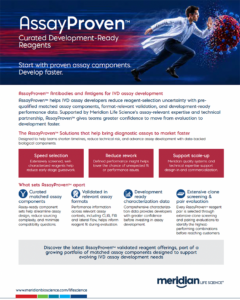
Explore the AssayProven™ flyer to see how curated reagent combinations and supporting performance data can help streamline feasibility and design—and view the available product portfolio.
FAQS
What makes AssayProven™ different from other matched antibody pairs or catalog reagents?
AssayProven™ brings together recommended reagent combinations selected through extensive candidate screening, testing in a relevant assay format, and comprehensive product-specific characterization. Meridian draws on its global development resources, manufacturing expertise, and strategic partnerships to evaluate antibody and antigen candidates and identify promising pairs.
Depending on the pair, supporting information may include sensitivity, specificity, cross-reactivity, affinity, correlation, and details of the materials and conditions used in testing. This gives IVD developers evidence beyond a catalog description or pairing recommendation, helping them choose a more informed starting point for evaluation in their own assay.
Does an AssayProven™ pair still require evaluation in my assay?
Yes. AssayProven™ provides screened components and supporting information to help you begin feasibility work. Your team still needs to assess the pair in its intended assay format, instrument, and sample matrix, then complete the optimization and validation appropriate for the finished assay.
What if my assay target isn’t listed in the AssayProven™ portfolio?
Contact Meridian Life Science’s technical team to discuss your target, intended assay format, and performance requirements. They can help you explore relevant antibodies or antigens in Meridian’s broader portfolio and discuss available options for your development program.
What are matched antibody pairs for immunoassay development?
Matched antibody pairs are capture and detection antibodies selected because they can work together to recognize the same target. In a sandwich immunoassay, the antibodies generally need to recognize different sites on the analyte so capture and detection can occur in the same assay. AssayProven™ provides recommended components selected through comparative screening together with relevant performance information.
How do I choose capture and detection antibodies for a sandwich immunoassay?
The best capture/detection orientation cannot always be predicted from the performance of individual antibodies. Pair combinations are typically evaluated experimentally for signal, background, sensitivity, specificity, and compatibility. AssayProven™ is designed to provide a more focused starting point by offering recommended combinations that have already undergone comparative evaluation.
What is antibody pair screening?
Antibody pair screening evaluates combinations of candidate capture and detection antibodies to identify pairs that provide suitable signal separation and analytical performance. It helps determine which combinations are most promising before broader assay optimization begins.
Why should antibodies be evaluated in the intended assay format?
Antibody performance can be influenced by assay architecture, sample matrix, labeling chemistry, membranes or surfaces, incubation conditions, and other variables. Product-specific format and evaluation information can therefore help developers judge potential fit earlier in development.
What performance data should I review when selecting immunoassay reagents?
Depending on the target and assay, useful evaluation information can include analytical sensitivity, specificity, cross-reactivity, correlation with an established method, affinity, sample matrix, and assay-format performance. The exact AssayProven™ data package varies by product.
Can pre-qualified antibody pairs eliminate assay optimization or validation?
No. Recommended or pre-qualified pairs can reduce the breadth of initial reagent screening and provide useful development information, but developers must still optimize and confirm performance in their own assay configuration, platform, sample matrix, intended-use population, and acceptance criteria.
Are AssayProven™ reagents available for LFA, FIA, and CLIA development?
Yes. The initial AssayProven™ portfolio includes products evaluated in lateral flow assay (LFA), fluorescence immunoassay (FIA), and chemiluminescent immunoassay (CLIA) formats. The supported format is product-specific (not in all formats) and should be confirmed in the associated technical documentation.
How can immunoassay blockers complement matched antibody pairs?
Even after a suitable antibody pair has been selected, sample-related interference and non-specific binding can affect assay performance. Immunoassay blockers can be evaluated during optimization to help address interference from HAMA, heterophilic antibodies, rheumatoid factor, and related sources.